In production at Georgia DOT Case study · Operations

TMC-React

The right procedure, the right contact, the right checklist at the moment an operator needs it.

6,000+Operator questions answered to date
<5 secTo get an answer
Every dayUsed every day since rollout
111Unique active users: operators, supervisors, and management
How operators use it

Traffic management center (TMC) operators work under time pressure, with standard operating procedures (SOPs) spread across hundreds of pages and contact lists that go stale the week they are printed. TMC-React answers procedure questions in plain language, resolves a location to the right responder, and builds an incident checklist from the agency’s own SOPs. Operators make every decision. The tool removes the search, not the judgment.

The problem it solves
  • Knowledge is fragmented. SOPs, contacts, and maps span hundreds of documents with no way to intelligently search across them.
  • Feedback loops are broken. When a contact has left or a step no longer applies, the fixes aren’t fast enough.
Why it matters

Minutes are a safety outcome. Every minute an incident stays open raises the odds of a secondary crash and keeps responders exposed. TMC-React puts the right step and the right contact in front of the operator in under 5 seconds.

Incident checklist

From the agency’s SOPs to a working checklist, with the right people already on it.
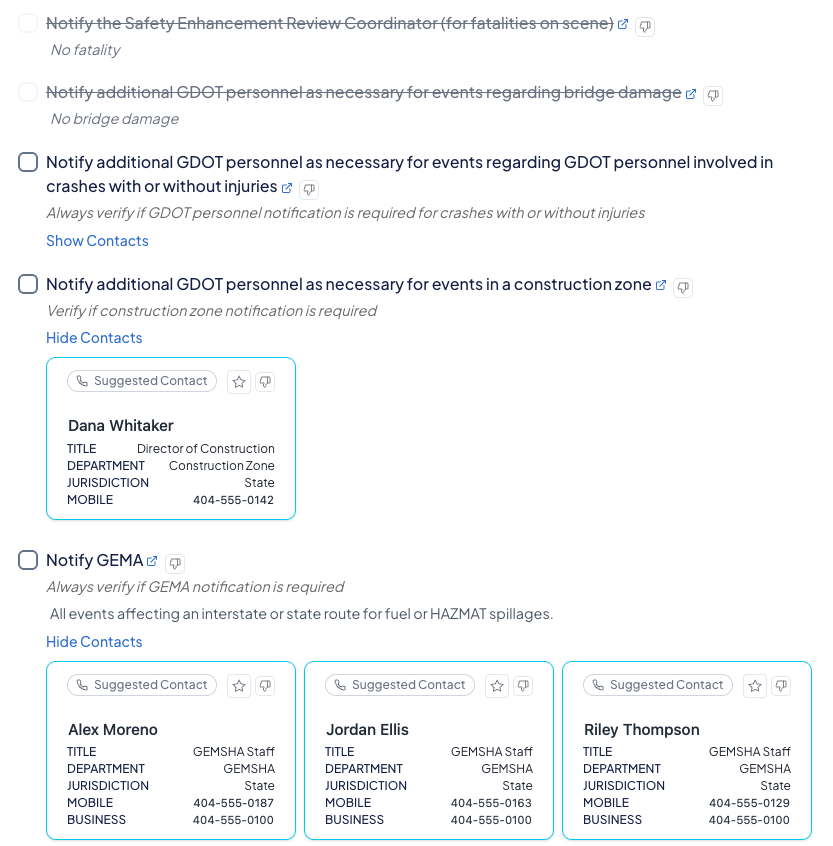
TMC-React incident checklist for a crash. Steps for bridge damage and fatalities are struck through because they do not apply. Steps that do apply show suggested contacts resolved for the incident: a Director of Construction for the construction-zone notification, and three GEMSHA staff for the GEMA notification, each with title, department, jurisdiction and phone numbers.
Steps from the SOPsEach action links to the exact passage it came from.
Contacts from the locationThe right responder, in call order, for where the incident is.
Nothing hiddenA step that does not apply is struck through, with the reason.
How it works: Pulse

TMC-React is built on Pulse, the data foundation under every Beacon product. Pulse connects into the agency’s ATMS and to the documents operators already rely on: SOPs, contact lists, and maps. It checks whether that data can be trusted and keeps its history. That is how an incident logged in the ATMS becomes a location, the right responder, and a checklist.

What operators ask

Managers see where operators are least certain, in the operators’ own words.

Questions by topic, so managers can aim training or SOP updates to where operators are uncertain.

SOP themes

Every SOP question is tagged to a theme. Notifications, signal and DMS operations, and TMC terminology lead: the questions an operator has to get right in the first minutes of an incident.

Top SOP themes

Share of 1,260 SOP questions, top 5 of 13

    TMC-React Insights Dashboard, Jul 23 – Oct 23, 2026.

    SOP heatmap: where the SOPs may be weak

    A sample set of GDOT procedures scored on five signals based on the questions operators actually asked. This analyzes the SOPs based on what people had to look up, re-ask, or double-check.

    Procedure Content gap% answers empty Asked again% re-asked Rule uncertainty% yes/no checks Procedure lengthmedian characters Exceptionsper 1,000 characters
    LowestHighest in column

    Each column is shaded across its own range, because the signals have different units. Rows are ordered by mean percentile across all five. Source: TMC-React query log, SOP questions in subtopics with 40+ questions, Jun 23 – Sep 1, 2026.

    Content gapThe answer reported nothing found. The SOP doesn’t cover it, or TMC-React can’t reach it.
    Asked againThe same question re-asked. The SOP exists but isn’t findable or memorable.
    Rule uncertaintyPhrased as a yes/no check. The operator half-remembers a rule and doesn’t trust it.
    Procedure lengthMedian characters to answer. Long means many steps and branches to hold in your head.
    ExceptionsConditionals and carve-outs per 1,000 characters. Every “unless” is a chance to get it wrong.
    What managers do with it

    Build training around what operators actually ask, by topic and by shift, and fix the SOPs that cause the most doubt first.

    After rollout

    What TMC-React helps them do.

    This is the best tool. Whoever came up with it is a genius and deserves a raise.

    TMC operator, unprompted · rollout meeting
    From GDOT leadership

    The feedback has been overwhelmingly positive. It’s really helped operators.

    Christina Barry · Assistant State Traffic Engineer, Georgia DOT
    Built to be audited

    Grounded, logged, cited, and scored every day.

    Grounded only.

    Guidance comes from agency-approved material. The system cannot invent a procedure.

    Fully logged.

    Queries, answers, feedback, and SOP revisions are timestamped and reviewable.

    Cited every step.

    Each action links to the exact passage it came from.

    Scored daily.

    An evaluation suite runs against the live system every day; results go to the agency.

    We measure answer quality

    Answer quality is graded daily against agency-reviewed tests, and Beacon publishes the scores to the agency.

    Relevance
    99.5 / 100
    Correctness
    90.1 / 100
    Faithfulness
    98.2 / 100
    Currently measuringImpact on incident clearance time.

    From pilot to every operator

    June 2025Pilot began at the Georgia DOT TMC
    April 2026Rolled out to every operator
    June 2026GDOT Commissioner Russell McMurry named TMC-React at ITS America as AI already delivering benefit
    Why Beacon

    The knowledge was always there. Now it answers back.

    Transportation agencies already have what AI needs: decades of procedures, contacts, and project history, written down and approved. What they haven’t had is a way to ask that knowledge a question and trust the answer. Beacon turns an agency’s own documents into answers, grounded in approved sources, cited to the passage, logged for audit, and scored daily against a set of tests.

    See it on your SOPs.

    Send us your procedures and contact lists and we’ll show you what TMC-React looks like on your documents.