Benchmark reads your agency's own delivery history and returns answers your engineers can trace back to the projects behind them. It begins with task-level hour estimates and extends into the decisions that gate a project further downstream.
When a project manager needs to estimate hours for a new roundabout, the right answer is hidden in the workbooks from the last 70 projects like it. The problem is there's no systematic way to find those workbooks, compare their task breakdowns, and build a new estimate from real data.
The result is estimates that rely on whoever happens to be in the room that day, and a concept-to-construction timeline one state DOT's Deputy Chief Engineer described as seven years for a single roundabout.
Not because the engineering is hard. Because the information is buried.
"The biggest gap is the knowledge transfer problem. When someone who's done 40 roundabouts retires, that knowledge walks out the door. We're trying to change that."
Jim Anderson, CEO, BeaconUpload your traffic engineering study. The tool does the rest.
Drop in your traffic engineering study or concept report. The tool reads it, extracting the project scope, location, and key attributes automatically.
Benchmark cross-references your project location against public data sources like wetlands, elevation, railroad crossings, and nearby parcels, all attributes that matter to construction cost.
Review what the tool extracted from your document and GIS data. Adjust anything that's off. This is the data that drives the match.
The tool finds the closest historical workbooks and explains the match. Not just a percentage, but a narrative: why these projects, and what they have in common with yours.
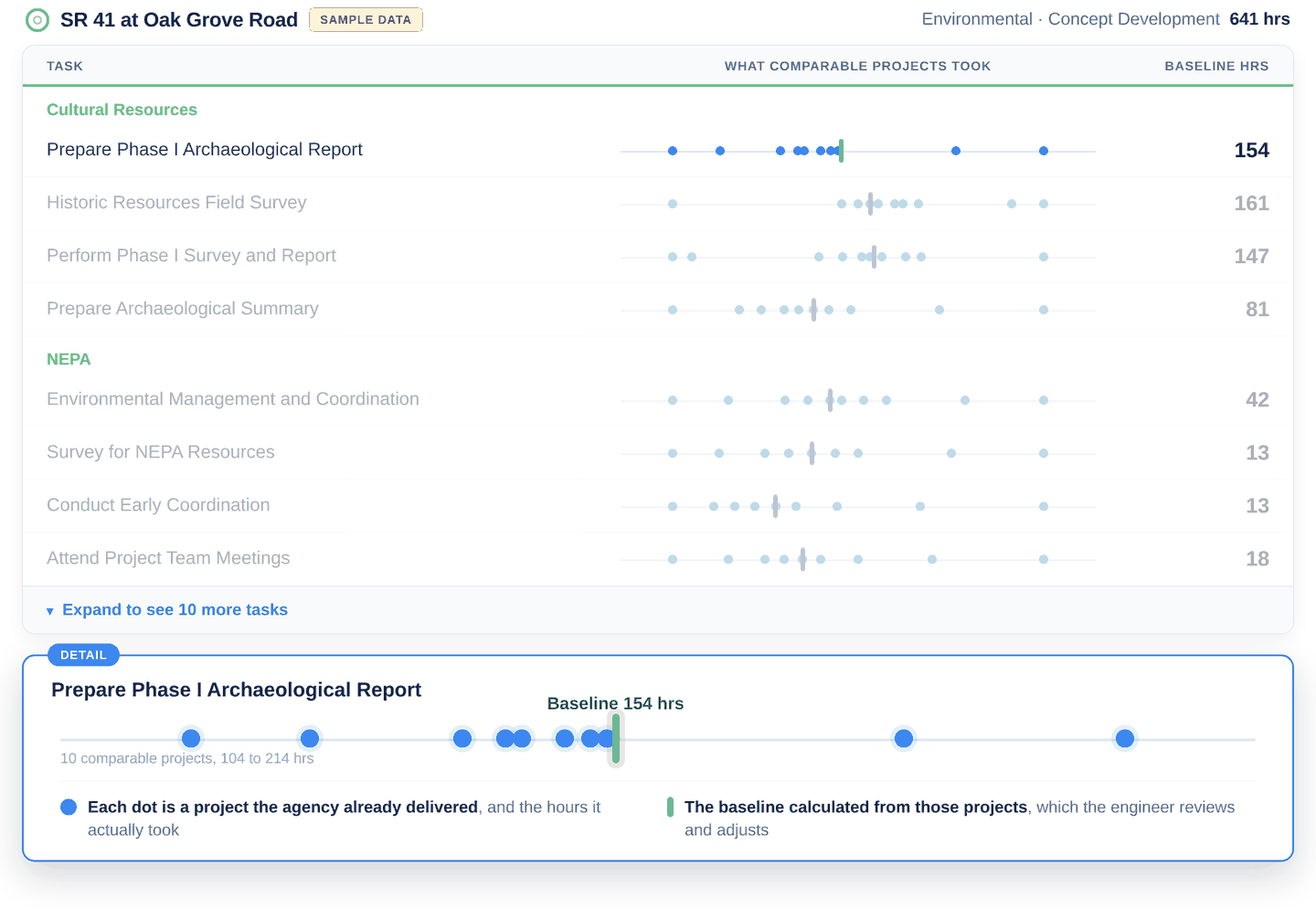
See recommended hours at the task level, the same granularity as the final negotiated cost workbook. Inspect the distribution. Click source project IDs. Edit any number.
Most tools give you a number. This one gives you the reasoning, the sources, and a record the next person inherits.
Benchmark doesn't give you a total. It gives you every task that comprises it, the same structure as the final negotiated cost workbook engineers build by hand. Roadway design, right-of-way, environmental review, project management: each broken out by task, with hours sourced from real projects.
Each task shows a scatter plot of hours across matched projects. A tight cluster means you can trust the number. A wide spread, or a cluster of zeros with one outlier, tells you to dig deeper before you commit. The data tells you how confident to be.
Benchmark uses AI to find and match comparable projects, then computes the hours in a deterministic layer. The numbers are calculated from real recorded values, not generated by a language model. That distinction is what makes an estimate defensible when someone asks how you arrived at it.
Click any project ID and download the actual historical workbook that contributed to your estimate. The estimate is not a black box. If you want to see the source, it's one click away.
Matching improves when attributes are rich. Benchmark supplements what's in your document with publicly available GIS data: elevation, wetland presence, railroad proximity, and nearby structures, so the comparison is based on the full picture of your site, not just what was written down.
Every number is editable. Add tasks, remove tasks, adjust hours. The tool gives you a data-grounded starting point; you bring the engineering judgment that no historical corpus can fully replace. That combination is better than either alone.
Built-in feedback capture lets you flag anything that seems off: a wrong match, a suspect number, a data error. Beacon receives it immediately and responds. When we've resolved it, we send you a note. That's a service level most software vendors don't offer, and most government agencies have never experienced.
Zeros in the scatter plot aren't noise. They're signal. If only one of four matched projects recorded hours for a task and the others show zero, that distribution is telling you something. The tool doesn't hide it. It shows it, and experienced engineers know exactly what to do with that information.
The corpus captures what retiring engineers carry. When someone who's done 40 roundabouts leaves, their judgment doesn't disappear. It's in the workbooks they supervised. Benchmark surfaces it. The institutional knowledge that used to walk out the door with the person now stays in the corpus.
Each project makes the next negotiation more defensible. Workbooks from completed projects flow back into the corpus. An agency running Benchmark today builds a stronger matching foundation every year, and every future estimate is backed by a richer, more current dataset than the one before it.
In August, GDOT expanded it from a pilot on one project type into a multi-year agreement running through 2031, covering more project types, more documents, and a commitment to examine every phase of project delivery.
The agency's ProjectWise environment holds more than 10 million documents and 20 terabytes of delivery history.
Engineering estimation is a retrieval problem that required two things to be ready simultaneously: a large enough corpus of digitized historical workbooks, and a model capable of reading and matching documents at scale. State DOTs had been building that corpus in ProjectWise for over a decade. LLMs arrived that could actually read it. The combination makes Benchmark possible, and it wouldn't have been five years ago.
An underestimate at concept development compresses the workbook at the moment you can't absorb it: the scope is set, the consultant is engaged, and negotiation happens under pressure. An overestimate burns political capital and creates a project that's hard to fund. Either way, the cost is downstream: renegotiation, schedule compression, or both. A data-grounded estimate doesn't eliminate the range. It narrows it and gives you a defensible anchor.
No. It's meant to give that judgment better material to work with. An experienced engineer looking at a scatter plot of hours across 15 matched projects will immediately see what's anomalous, what's explained by site conditions, and what warrants a call to the consultant. The tool produces a starting point. The engineer closes the gap.
Significantly. When the first number in a negotiation comes from your own historical corpus rather than the consultant's estimate, the dynamic shifts. You're not reacting to their number; you're anchoring from yours, with source workbooks to back it up. Agencies that have tried this describe it as the first time they felt like they were negotiating from a position of knowledge rather than hope.
It compounds. Workbooks from completed projects are added to the corpus as they finish, and match quality improves as volume grows. An agency running Benchmark today will have a stronger data foundation next year, and a richer set of precedents for every estimate and every negotiation after that. The tool gets more useful the longer it runs.
Every number is editable. Every task can be added or removed. The tool is designed to produce something engineers want to interrogate, not something they're expected to accept. If a number surprises you, click the source and see where it came from. The goal is a better starting point than a blank workbook, not a finished estimate that bypasses engineering judgment.